
old_tid
73
Mason White

23.04.26 - Mason White appointed dean of U of T’s John H. Daniels Faculty of Architecture, Landscape, and Design

Mason White, an award-winning scholar and designer, has been appointed dean of the University of Toronto’s John H. Daniels Faculty of Architecture, Landscape, and Design.

A faculty member at Daniels since 2005, White is an expert in architecture, urban design and the relationship between architecture, environment and society – with a focus on cold climates.

He will assume his new role on July 1, 2026 for a five-year term. His appointment was approved Wednesday following an extensive international search. 

“Having taught here for 20 years already, it is an incredible honour to have the opportunity to support our students, faculty and staff as they pursue even greater heights,” said White. “I’m really excited for the challenge ahead and for the future of this faculty, which brings together a remarkable diversity of perspectives across disciplines and practices.”

White is renowned for his research, architecture and design work in cold environments and across scales – from individual buildings to entire cities and regions. A founding partner of Lateral Office, an interdisciplinary design practice, White often collaborates with Indigenous partners on community‑empowering research and design projects.

He has held several leadership roles at Daniels, including director of the master of architecture and master of urban design programs, as well as the post-professional master of architecture and master of landscape architecture programs.

Trevor Young, U of T’s vice‑president and provost, congratulated White on his appointment.

“Professor White’s commitment to research and practice excellence will be key to the continued success of the John H. Daniels Faculty of Architecture, Landscape, and Design in the years ahead,” said Young. 

“His scholarly vision and collaborative focus will guide Daniels students and faculty in exploring innovative ways to shape the spaces and experiences that enrich our lives, and in responding thoughtfully to social and environmental challenges.”

Young also thanked Professor Robert Levit for his exceptional service as acting dean since August 2023.

A Fellow of the Royal Architectural Institute of Canada, White has served as a primary investigator and collaborator on several major arts and tri‑council grants – with more than $2.4 million in funded research – and has lectured and exhibited extensively across the United States, Canada, South America, Europe and Asia. 

He is the founding editor of the journal Bracket, co-author of Many Norths: Spatial Practice in a Polar Territory, co-editor of Third Coast Atlas: Prelude to a Plan and has had his work and writing featured in major newspapers, magazines and journals.

With bachelor’s and master’s degrees in architecture from Virginia Tech and Harvard University, respectively, White said Daniels’ evolution – from a school of architecture, landscape architecture and urban design to a faculty that also includes forestry and visual studies – puts it in a unique position to perform high-impact interdisciplinary work.

“There are powerful overlaps between disciplines that are all hosted under one roof here – literally,” said White, who has received multiple awards for his work – both personally and via Lateral Office.

“From realms like forestry and landscape architecture, whose connections are obvious, to less apparent – yet promising – links between urban design and visual studies, we can combine how these disciplines have traditionally worked while examining their shared interests.”

As dean, White said he is eager to strengthen relationships with Daniels alumni and foster new research partnerships at U of T and beyond – all while emphasizing collaboration, creativity and community engagement.

“We want to support and train design leaders who are collaborative and creative,” he said. “That means finding a balance between the technical skills that students need and the human, community‑facing leadership the world requires.”

Story by Rahul Kalvapalle republished from U of T News

Photo by Polina Teif

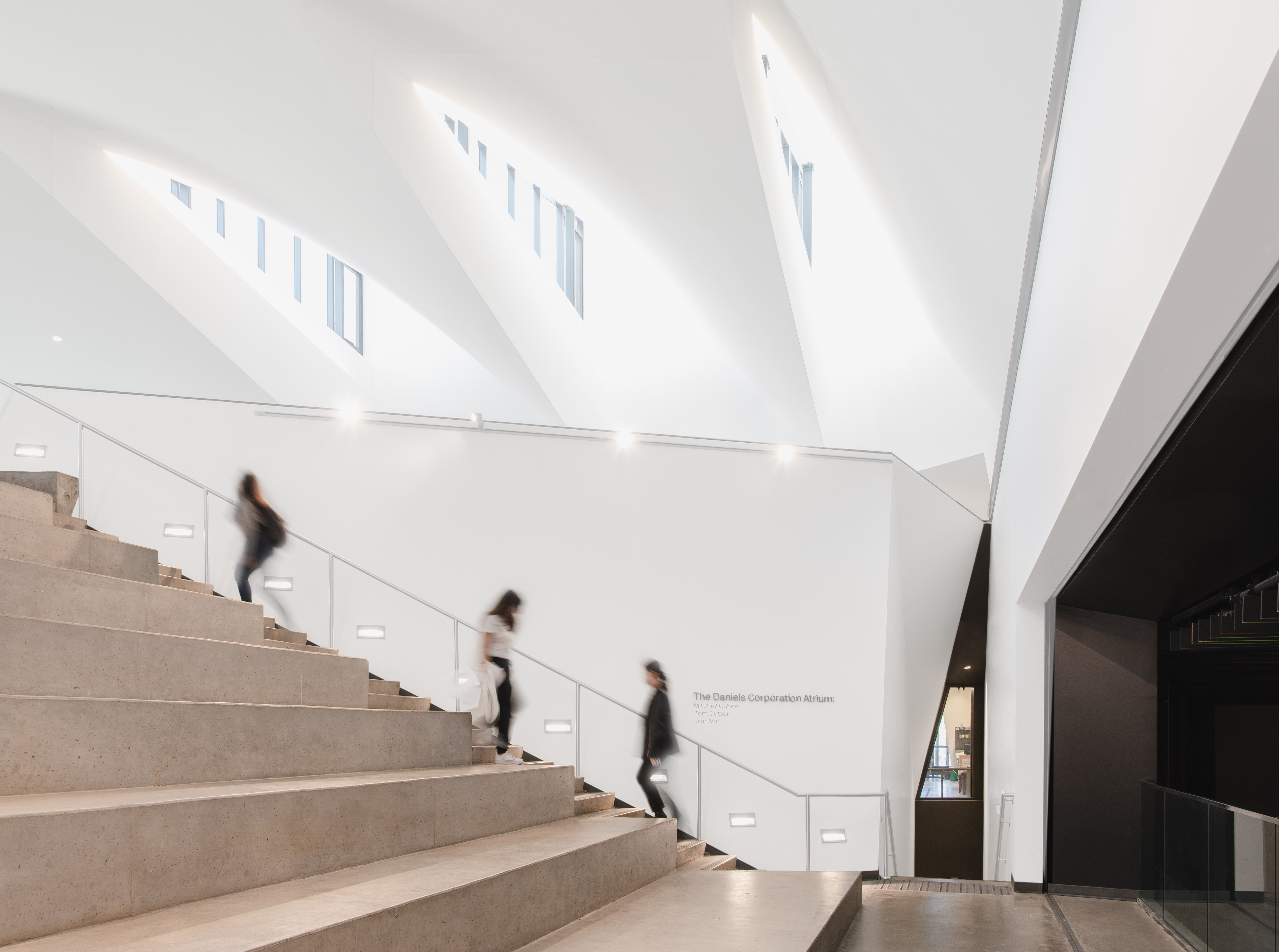
Two students walking through the Daniels Corp amphitheatre where project models are displayed

23.05.26 - Explore our End of Year Exhibitions

All events are free and open to the public. No registration required.


End of Year Show 2025/26

A Daniels tradition encompassing a wide range of projects, this exhibition showcases student work from across our degree programs in architecture, forestry, landscape architecture, urban design, and visual studies. The models, drawings, graphics and videos displayed in the third floor studio at 1 Spadina Crescent, demonstrate our students' approaches to the objects and environments they imagine, create and nurture.

Opens May 23 (Doors Open Toronto) and closes June 3, 2026


Existing Futures: Teaching Experiments in Maintenance, Media and Urban Occupation

Exhibition talk: Sunday, May 24, 5:00 p.m.  in the Daniels Building Main Hall  |  Larry Wayne Richards Gallery hours extended Sunday, May 24 until 6:00 p.m.

Curated by
University of Tokyo Associate Professor of Architecture Yusuke Obuchi
Daniels 2025/26 Frank Gehry International Visiting Chair in Architectural Design

The future does not emerge from the constant pursuit of the new, but from reimagining what already exists.

This exhibition in the Larry Wayne Richards Gallery brings together teaching experiments and student work from three courses Obuchi taught at Daniels: “Radical Maintenance,” “Analog Machine: I Am Here” and “Urban Nomad.” Through acts of observation, repair, reconstruction, and fabrication, these projects explore how architecture can emerge from unrealized potentials already present in our environments, materials, and social conditions.

This exhibition is generously supported by the Frank Gehry International Visiting Chair in Architectural Design endowment.


MVS in Studio Art Graduating Student Exhibitions

Architecture + Design Gallery
Daniels Building, 1 Spadina Crescent (Map)

Opening reception: Thursday, April 30, 6:00—8:00 p.m.

The Art Museum at the University of Toronto, in partnership with the Daniels Faculty, is pleased to present the graduating projects of the 2026 Master of Visual Studies (MVS) in Studio Art graduate students: Helio Eudoro, Rita Ferrando, Pamila Matharu, and Cullen Ritchie. The exhibitions mark the culmination of years of rigorous research and studio practice, offering a first public look at new bodies of work by each graduating student artist.

Closes July 15, 2026

Helio Eudoro, Shrine, 2026. Assemblage (detail), 30″ x 28″ x 24″. Image courtesy of the artist; Rita Ferrando, Modern Nature, 2026. Film still, 1.33:1, colour. Image courtesy of the artist; Pamila Matharu, Untitled 2, 2025. Colour photograph, variable dimensions. Image courtesy of the artist; Cullen Ritchie, Half Mile, 2026. Video still, 16mm film print, digitized, 02:30 mins, looping. Image courtesy of the artist.


MVS in Curatorial Studies Graduating Student Exhibitions

Opening reception: Wednesday, May 6, 6:00–8:00 p.m.

Little and Often traces how our relationships to land, material, and community are sustained within disturbed landscapes and conditions of precarity. Working with seeds, soils, mushrooms, and plants, the artists in this exhibition foreground resilience as a collective, relational practice, continually shifting under constraint. Little and Often is curated by Chloe Gordon-Chow and features works by Maureen Gruben, Rachel Crummey, Miguel Caba, Rana Nazzal Hamadeh, and Meech Boakye and Bhavika Sharma.

Curated by Gia Liapi, Blind Spot explores the potentials of finding new uses for the tools already in our hands. Through video, installation, performance, and software, artists Shadi Habib Allah, Shu Lea Cheang, Jeremy Laing, Lou Sheppard, and Iris Touliatou examine how legibility and classification produce value to open conversations about alternative architectures to learn from and with.

The exhibitions are produced as part of the requirements for the Master of Visual Studies (MVS) in Curatorial Studies at the Daniel Faculty. 

All images courtesy of the artists (Little and Often): Rana Nazzal Hamadeh, Something from there, 2020. Still from video, 07:00 mins, Arabic, English (with subtitles in English); Maureen Gruben, Nuna Aliannaittuq, 2025. Process photo; 4,800 clay beads, cotton thread (size varies). Photo by Kyra Kordoski; All images courtesy of the artists (Blind Spot): Shadi Habib Allah, Did You See Me This Time With Your Own Eyes?, 2018. Single-channel HD, 07:00 mins. Image courtesy of the artist and Sylvia Kouvali, London / Piraeus; Shu Leah Cheang, UTTER, 2023. 36-minute video loop. Image courtesy of the artist.

Photo of the graduate design studio at top of page by Alice Xue Photography

daniels building grad studio

23.05.26 - Visit the Daniels Building during Doors Open Toronto 2026

Text: Doors Open Toronto May 23 & 24, 2026

10:00 a.m. to 5:00 p.m. 

Ever wondered what's inside 1 Spadina Crescent? Curious about the history of the revitalized neo-Gothic building at its centre? 

Whether you have always wanted to wander the halls or simply haven’t visited the Daniels Building in a while, there is something for everyone to discover during Doors Open Toronto 2026

Family-friendly

The Daniels Building welcomes visitors for public tours, May 23 & 24 between 10 a.m. and 5 p.m. 

The Toronto Society of Architects (TSA) will host a children's activity in our Commons (main floor atrium) on both days. Participants will be encouraged to think about buildings, landscapes and urban infrastructures through Building a Paper City.

Sunday lecture: What is Toronto's architectural identity?

TSA will also host a special discussion on the topic of Toronto's architectural identity, Sunday, May 24 from 3:00 to 4:30 p.m. in the Daniels Building Main Hall. All welcome!

Student work showcase

While you're here, our End of Year Show 2025/26 will feature a wide range of projects produced in our architecture, landscape architecture, forestry, urban design and visual studies programs. The drawings, graphics, models and videos displayed throughout the Daniels Building demonstrate an exuberance for innovative digital and physical approaches to the objects and environments we imagine, create and nurture.

History 

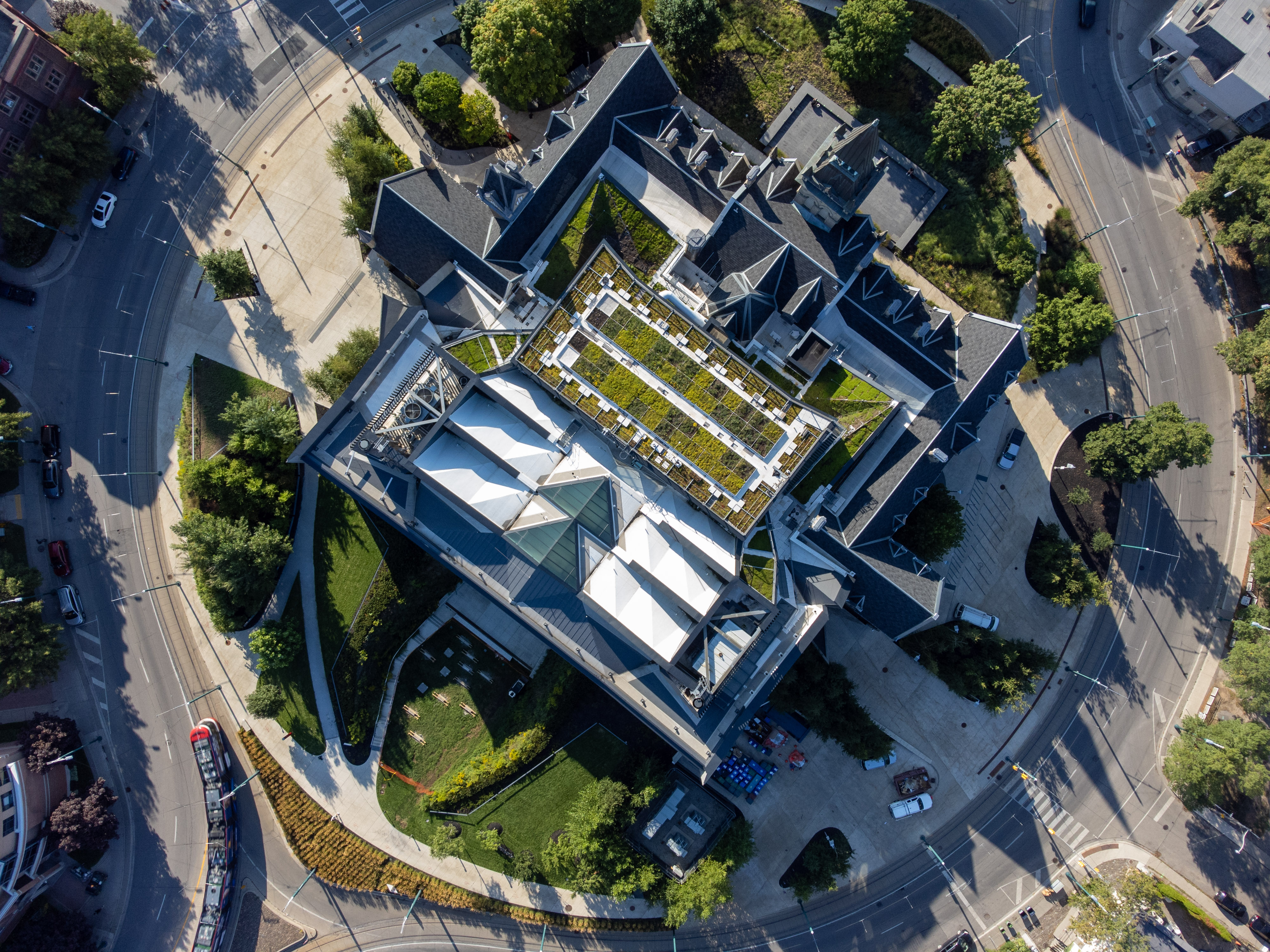
Originally built as a prospect to the lake, the historic structure at 1 Spadina Crescent was the first site of Knox College in 1875, a military hospital during the First World War and the place where Connaught Laboratories manufactured insulin in the 1940s. Today, it’s home to the John H. Daniels Faculty of Architecture, Landscape, and Design at the University of Toronto.

A striking contemporary addition, designed by NADAAA and completed in 2018, combines the Knox College structure with cutting-edge facilities, from versatile new studios to a digital fabrication lab.

Admission to the Daniels Building and to all Doors Open venues is free. A dedicated brochure with descriptions of events that are happening during Doors Open will be available for visitors.

Visit the Doors Open Toronto website for a full list of participating sites.

John Ecker, Chair, Board of Directors, Ontario Heritage Trust, Assistant Professor, Teaching Stream, Amory Ngan, and the Honourable Edith Dumont, Lieutenant Governor of Ontario at the April 17 Ontario Heritage Trust awards ceremony

05.05.26 - Amory Ngan receives Lieutenant Governor’s Ontario Heritage Award for Excellence in Conservation

John Ecker, Chair, Board of Directors, Ontario Heritage Trust, Assistant Professor, Teaching Stream, Amory Ngan, City of Mississauga, forestry manager, and the Honourable Edith Dumont, Lieutenant Governor of Ontario at the April 17 Ontario Heritage Trust awards ceremony (photo by Dahlia Katz courtesy of the Ontario Heritage Trust).

City of Mississauga, forestry manager, Amory Ngan, an assistant professor, teaching stream, in the Institute of Forestry and Conservation at U of T’s John H. Daniels Faculty of Architecture, Landscape, and Design, leads the team being recognized with the Lieutenant Governor’s Ontario Heritage Award for Excellence in Conservation.

The Ontario Heritage Trust works to preserve and celebrate Ontario’s cultural and natural heritage and keep it and meaningful for future generations. The Lieutenant Governor’s Ontario Heritage Awards recognize volunteers, professionals and organizations for their heritage contributions.

The City of Mississauga is Ontario’s first municipality to use goat grazing for invasive plant species management. In 2025, the project "Prescribed Grazing for Invasive Plant Control, Mississauga," was expanded to cover five wetlands, woodlands and parks throughout the city. The approach combines traditional grazing with modern monitoring to tackle invasive plant species, reducing herbicide use, preventing seed spread while reaching difficult terrain.

“This recognition celebrates innovative work to protect Ontario’s natural heritage,” says John Caspersen, director of forestry programs at the Daniels faculty. “It’s inspiring to see Amory and the City of Mississauga forestry team honoured, and the impact of their work recognized across Ontario.”

Ngan accepted the award on behalf of the City of Mississauga’s forestry division at the Lieutenant Governor’s Ontario Heritage Awards on April 17.

Robarts Library cherry blossoms (photo by Polina Teif)

01.05.26 - Campus in bloom: U of T forestry expert on cherry blossom season

(photo by Polina Teif/University of Toronto)
 

Many of Toronto’s cherry blossom (sakura) trees were gifted to the city by Japanese and Japanese-Canadian individuals and organizations as a gesture of gratitude for Toronto’s support in welcoming Japanese Canadians who were displaced during and after World War II.

The University of Toronto received many of its sakura trees from the Consulate General of Japan as part of the Sakura Project in 2005. But to enable their growth here, the sakura is grafted on top of sweet cherry rootstock.

“There’s a row of Japanese flowering cherry trees on Ursula Franklin Street,” explains Danijela Puric-Mladenovic, an assistant professor at U of T's Institute of Forestry & Conservation in the John H. Daniels Faculty of Architecture, Landscape, and Design.

Cherry blossoms near the Daniels Building on Ursula Franklin Street (photo Nina Haikara)

“On one tree, a single branch is already in full bloom with white flowers. This branch belongs to a sweet cherry, which serves as the rootstock onto which the Japanese flowering cherry was grafted." 

“At some point, a branch from the rootstock began to grow and has since become part of the tree’s canopy. Because it is genetically distinct, it blooms earlier and produces white flowers rather than the typical pink blossoms. It’s an example of grafting and tells an interesting story about how different species respond to seasonal conditions,” says Puric-Mladenovic, who teaches courses in landscape ecology, forest conservation and green urban infrastructure, among others.

Puric-Mladenovic’s research and professional practice centre on forests within developed and urban settings. She focuses on creating practical tools and solutions that inform strategic conservation, restoration and integrated spatial planning of green infrastructure, vegetation and forest systems across urban and agricultural landscapes. In collaboration with Professor Emeritus Andy Kenney, she co-developed Neighbourwoods©, a tree inventory and monitoring protocol.

Puric-Mladenovic says weather, of course, plays an important role in bloom development. She says this year’s spring brought out leaves at the same time as buds, which is atypical.

“In cooler springs, leaves have more time to emerge alongside the flowers, which can make the display appear less vibrant due to the added green,” she says. “In contrast, a sudden warm spell rushes flower development, often resulting in a more intense burst of pink blossoms.”

The U of T researcher also notes that not all Japanese flowering cherries bloom at the same time. She says there are many different cultivars, which are varieties that have been specially bred or selected, and each has its own timing.

“There are other cherry species on U of T campus, including our native Prunus virginiana—chokecherry—which typically blooms after its leaves have already developed. Some ornamental cherries, like ‘February pink’ or ‘Accolade,’ can bloom weeks before the more familiar Yoshino cherries, so across Toronto, the cherry blossom season unfolds in stages rather than all at once; and besides the weather, different cultivars that naturally bloom at different times can also confuse people.”

Puric-Mladenovic suggests this weekend marks the peak of the cherry blossom season in Toronto’s High Park. In addition to the white blooms on Ursula Franklin Street, more cherry blossoms can be found outside Robarts Library and along the pathways of the Landmark Project on U of T's St. George campus. 

Republished at U of T News

Karim and master's student Christine Bogle taking measurements along College Street.

27.04.26 - City trees are leaking greenhouse gases—but U of T researchers say there's a fix

It is well known that urban trees help mitigate climate change impacts by shading and evaporative cooling, and also are important sinks for atmospheric CO2. But what about the other major greenhouse gases, namely methane (CH4) and nitrous oxide (N2O) that together account for about one-third of global warming?

Daniels forestry PhD student Mohd. Rezaul ("Rony") Karim and Professor Sean Thomas made an educated guess about urban trees that grow in soils subject to all manner of insults and injuries, ranging from compaction to dog pee: namely, that these soil conditions would lead to production of non-CO2 greenhouse gases both from the soil and, when channeled though the water-conducting xylem vessels, these gases would then be emitted from tree leaves.

Equipped with new-generation ultra-sensitive gas analyzers and a measuring system developed by U of T forestry affiliate startup company CredoSense LLC, Karim and Thomas found that, sure enough, representative urban street trees in Toronto do show greenhouse gas emissions both from the soil surface of planting pits, and from leaves. The emission rates are much lower, than, say, landfills—but the total leaf area of urban trees is hundreds of times larger, so the total effect is significant.

Karim and Thomas also examined street trees where the soil was treated with biochar, a charcoal-like material made from wood waste materials, and currently being used in a city-wide trial coordinated by the Thomas Lab (with funding from the Natural Sciences and Engineering Research Council's Alliance Mission grants program). Remarkably, trees with surface treatments of biochar showed not only reduced emissions of methane and nitrous oxide, but in the case of methane both soils and tree leaves were taking up methane from the atmosphere.

The takeaway from this research is both cautionary and hopeful: urban trees remain vital climate allies, but their role is more complex than previously thought. With better soil management, Toronto and other cities may be able to unlock even greater climate benefits from the forests already growing along our streets.

Karim and Thomas's paper, "Urban Tree Channeling of Soil Methane and Nitrous Oxide and Its Mitigation Using Biochar," is published today in Environmental Science & Technology.

2026 Winter Field camp group photo

01.04.26 - OPFA features MCF graduate journey and roots of U of T field camp

Ontario's regulator of professional foresters (RPF), the Ontario Professional Foresters Association, features an article by master of forest conservation graduate Stevie Rae Luzzi (MFC 2024) in the latest issue of The Professional Forester.

Sharing our roots: journeys to becoming a professional forester introduces some of Ontario’s new registered and associate professional foresters by sharing the personal stories behind their decision to join the profession and their experience as a professional forester so far. It highlights the wide range of backgrounds and career paths that strengthen forestry in Ontario and the value this diversity brings to the profession.

In another story, RPF and alumnus Fred Pinto (BScF 1978) and John Pineau, content and production coordinator for The Ontario Woodlander magazine, trace the origins of the U of T field camp to the Temagami forestry protests of the early 1990s.

Read the latest issue of The Professional Forester (PDF)

Photo at Sugarstone Farm courtesy of John Pineau

08.04.26 - Winter 2026 Reviews (April 8-29)

Wednesday, April 8 to Wednesday, April 29
Daniels Building
1 Spadina Crescent

Whether you're a future student, an alum or a member of the public with an interest in architecture, forestry, landscape architecture or urban design, you're invited to join the Daniels Faculty for Winter 2026 Reviews. 

Throughout April, students from across our undergraduate and graduate programs will present final projects to their instructors and guest critics from academia and the professional community. 

All reviews will take place in the Daniels Building at 1 Spadina Crescent from 9 a.m. to 6 p.m. (unless otherwise stated). Follow @uoftdaniels on Instagram and join the conversation using the hashtags #danielsreviews and #danielsreviews26. 

Please note that times and dates are subject to change. 

Current students should reference the Final Examinations & Reviews schedule for more information.


Wednesday, April 8  

Design + Engineering I (ARC112) | Undergraduate
Instructors: Jay Pooley & Mahsa Malek
Room: 200

Exploring Design Practices (ARC302) | Undergraduate
Instructor: Richard Sommer
Room: Main Hall 

Thursday, April 9  

Design Studio I: How to Design Almost Anything (JAV101) | Undergraduate
Coordinator: Petros Babasikas
Instructors: Anthony Kalimungabo, Mo Soroor, Reza Nik, Erica Kim, Scott Sorli, Harry Wei, Kara Verbeek, Katy Chey, Jeannie Kim
Rooms: Main Hall (170A, 170B), 215, 230, 330 

Friday, April 10  

Drawing and Representation II (ARC200) | Undergraduate
Coordinator: Jeffrey Garcia
Instructors: Roberto Damiani, Nova Tayona
Room: 330

Design Studio II: How to Design Almost Nothing (ARC201) | Undergraduate
Coordinator: David Verbeek
Instructors: Francesco Valente-Gorjup, Daniel Briker, Anne-Marie Armstrong, Maria Denegri, Adrian Phiffer, Michael Piper, Anne Ma, Jay Pooley, Miles Gertler, Fiona Lim Tung
Rooms: Main Hall (170A, 170B, 170C), 230, 215, 240, 2/F hallway


Monday, April 13

Architecture Studio IV (ARC362) | Undergraduate
Coordinator: Shane Williamson
Instructors: Chloe Town, Laura Miller
Rooms: Main Hall (170A, 170B), 230

Technology Studio IV (ARC381) | Undergraduate  
Instructors: Paul Howard Harrison, Suzan Ibrahim
Room: 330

Tuesday, April 14

Design Studio 2 (LAN1012) | Graduate
Instructors: Behnaz Assadi, Liat Margolis
Rooms: Main Hall (170A, 170B, 170C)

Comprehensive Studio III (ARC369) | Undergraduate  
Coordinator: Daniel Briker
Instructors: Mauricio Quiros Pacheco, Fiona Lim Tung
Rooms: 209, 215, 230
Time: 10:30 a.m. - 4:30 p.m. 

Multidisciplinary Capstone Design Seminar (ARC491) | Undergraduate  
Instructor: Erica Kim
Room: 330

Wednesday, April 15

Architectural Design Studio 2 (ARC1012) | Graduate  
Instructors: Fiona Lim Tung (Coordinator), Shane Williamson, John Shnier, Behnaz Assadi, Mauricio Quiros Pacheco, Laura Miller
Indigenous advisor: PhD candidate James K. Bird
First Peoples Leadership Advisory Group: Amos Key Jr., Trina Moyan, Dorothy Peters
Rooms: Main Hall (170A, 170B), 215, 230, 240, 330

Landscape Architecture Studio IV (ARC364) | Undergraduate   
Instructor: Peter North 
Room: 315

Undergraduate Thesis
ARC462

Senior Seminar in Design
Instructor: Jeannie Kim  
Room: 209
Time: 1:00 p.m. - 4:00 p.m.

Thursday, April 16

Comprehensive Studio (ARC2014) | Graduate 
Coordinators: James Macgillivray, Aleris Rodgers
Instructors: Maria Denegri, Jon Cummings, Steven Fong, Pina Petricone, Christopher Cornecelli, Carol Phillips
Rooms: Main Hall (170A, 170B, 170C), 215, 230, 240

Design Studio 4 (LAN2014) | Graduate  
Instructors: Robert Wright, Francesco Martire, Todd Douglas
Room: 330

Friday, April 17

Comprehensive Studio (ARC2014) | Graduate 
Coordinators: James Macgillivray, Aleris Rodgers
Instructors: Maria Denegri, Jon Cummings, Steven Fong, Pina Petricone, Christopher Cornecelli, Carol Phillips
Rooms: Main Hall (170A, 170B, 170C), 215, 230, 240

Design Studio 4 (LAN2014) | Graduate  
Instructors: Robert Wright, Francesco Martire, Todd Douglas
Room: 330


Monday, April 20

Urban Design Studio 2 (URD1012) | Graduate
Instructor: Nusrat Jahan Mim
Room: Main Hall (170A)

Selected Topics in Advanced Computer Applications (ARC3202) | Graduate
Instructor: Alstan Jakubiec
Room: Main Hall (170B)
Time: 9:00 a.m. - 12:00 p.m.

Selected Topics in Architecture (ARC365) | Undergraduate
Instructor: Adrian Phiffer
Room: Main Hall (170B, 170C)
Time: 1:00 p.m. - 4:00 p.m.

Graduate Thesis
LAN3017

Design Studio Thesis
Coordinator: Elise Shelley
Instructors: Behnaz Assadi, Liat Margolis, Francesco Martire, Fadi Masoud, Peter North, Robert Wright
Rooms: 209, 215, 230, 240, 242, 315, 330, 340

Tuesday, April 21

Advanced Topics in Architecture (ARC465) | Undergraduate
Instructor: Zachary Mollica
Room: Main Hall (170C)
Time: 1:00 p.m. - 4:00 p.m.

Graduate Thesis
LAN3017, URD2015

Design Studio Thesis
Coordinator: Elise Shelley
Instructors: Behnaz Assadi, Liat Margolis, Francesco Martire, Fadi Masoud, Peter North, Robert Wright
Rooms: 209, 215, 230, 240, 242, 315, 330, 340

Urban Design Studio Thesis
Coordinator: Mason White
Instructors: Michael Piper, Roberto Damiani, Nusrat Jahan Mim, Mariana Leguia Alegria, Angus Laurie, Simon Rabyniuk
Rooms: Main Hall (170A, 170B)

Wednesday, April 22

Graduate Thesis
ARC3021

Almost Ordinary
Instructor: Michael Piper
Rooms: 209, 230, 240

Rehearsing the Parade: Ephemeral Architectures and Persuasion on the Move
Instructor: Miles Gertler
Room: Main Hall (170B), 330 

Public, Building, Forms
Instructor: Adrian Phiffer
Room: Main Hall (170A) 

Thursday, April 23

Graduate Thesis
ARC3021

Trading Places
Instructor: Jeannie Kim
Rooms: 330, 340

When the Impossible Happens
Instructor: Brian Boigon
Room: 230
Time: 9:00 a.m. - 1:00 p.m.

The Archipelago Studio
Instructor: Petros Babasikas
Rooms: Main Hall (170B, 170C)

Public, Building, Forms
Instructor: Adrian Phiffer
Room: Main Hall (170A) 

Friday, April 24

Thesis II (ALA4022) | Post-Professional
Coordinator: Mason White
Instructors: Brady Peters, Robert Wright, Fiona Lim Tung, Nusrat Jahan Mim, Alstan Jakubiec, Brady Peters
Rooms: 209, 242, 2/F hallway

Graduate Thesis
ARC3021

Trading Places
Instructor: Jeannie Kim
Rooms: 230, 340

Architecture and the Right to Housing
Instructor: Karen Kubey
Rooms: Main Hall (170C), 215, 240

Design Technologies
Instructor: Humbi Song
Rooms: Main Hall (170A, 170B)

Bioregional Futures
Instructor: Sam Dufaux
Rooms: 330, Outdoor Courtyard


Monday, April 27

Undergraduate Thesis
ARC457, ARC462, ARC487

Senior Seminar in History and Theory
Instructor: Simon Rabyniuk
Room: Main Hall (170A, 170C)

Senior Seminar in Design
Instructor: Jeannie Kim  
Room: Main Hall (170B), 240 (a.m.), 242 (p.m.)

Senior Seminar in Technology
Instructor: Nicholas Hoban
Rooms: 230, 242 (a.m.)
Time: 10:00 a.m. - 6:00 p.m.

Tuesday, April 28

Undergraduate Thesis
ARC457, ARC462, ARC487

Senior Seminar in History and Theory
Instructor: Simon Rabyniuk
Room: Main Hall (170A, 170C)

Senior Seminar in Design
Instructor: Jeannie Kim  
Rooms: Main Hall (170B), 209, 242 (p.m.), 330

Senior Seminar in Technology
Instructor: Nicholas Hoban
Room: 230, 242 (a.m.), 1/F Hallway
Time: 10:00 a.m. - 6:00 p.m.

Wednesday, April 29

Selected Topics in Architecture (ARC3703) | Graduate
Instructor: Laura Miller
Room: 330

Modeling and Fabrication in Design (ARC280) | Undergraduate
Instructor: Brady Peters
Room: 215, 230, 240, 2/F Hallway
Time: 9:00 a.m. - 1:00 p.m

Design & Community-Engagement  Capstone Project (ARC492) | Undergraduate
Instructors: Michael Piper & Joshua Kirk
Room: Main Hall (170B, 170C)
Time: 9:00 a.m. - 2:00 p.m

Attendees of Building Indigenous Representation at Daniels on January 17

05.03.26 - Building Indigenous Representation at Daniels (BIRD) takes flight in its pilot year

The Indigenous Task Force of the Royal Architecture Institute of Canada (RAIC) states there are only 20 registered Indigenous architects in Canada. This number represents one-fifth of the 1 per cent of prasticing architects in the country.

“Within the Daniels student body, we have only ten Indigenous students out of more than 1,500,” says Trina Moyan, who is Nehiyaw (Plains Cree) from Frog Lake First Nation. “Because of the policies in the Indian Act, our Peoples have been made vulnerable and marginalized for generations. These ten students have lived through the impacts of that history. They have pushed through and fought hard to get here. BIRD – Building Indigenous Representation at Daniels – is about increasing future student enrolment.”

Launched in January as a six-month pilot, BIRD is supported by the University of Toronto’s Access Strategy and Partnerships Office and its Access Programs University Fund (APUF), dedicated to supporting U of T initiatives that reduce barriers to education.

“Creating a sense of familiarity and comfort within the Daniels environment and the university broadly will hopefully inspire Indigenous students to apply to these programs,” says Jewel Amoah, assistant dean of equity, diversity and inclusion at the Daniels faculty.

BIRD has been informed by consultations with internal U of T partners engaged in supporting access and outreach for Indigenous students, including the Office of Indigenous Initiatives, First Nations House and the Indigenous Recruitment Officer, as well as Indigenous students at Daniels, Greater Toronto Area school boards and local architecture firms engaged in projects with Indigenous communities.

"This broad collaboration in the design and implementation of BIRD reflects our intention to engage Indigenous voices with and in the Daniels community," says Robert Levit, acting dean of the faculty. "Our response to the Calls to Action begins with establishing access for Indigenous youth to Daniels and helping these young people to build relationships with the people and programs across our community."

Through grassroots outreach—including to the Indigenous knowledge‑centred Kapapamahchakwew (Wandering Spirit School) in Toronto, the Urban Indigenous Education Centre and the Eshkiniigjik Naandwechigegamig (ENAGB) Indigenous Youth Agency—twenty urban youth are participating in this year’s pilot.

The program is coordinated by members of the Indigenous Students' Coalition at Daniels, Angel Levac (Tyendinaga Mohawk Territory) and Shadrak Gobert (Frog Lake First Nation).

"Through my outreach for the program, I found that Indigenous youth are genuinely excited about what Daniels has to offer,” says Gobert. “What stood out most is that our young people are motivated, capable, and ready to lead and make change; they just need access to opportunity and a strong support system to help them thrive. Many simply weren't aware of the range of opportunities and programs that are available to them. BIRD aims to be a meaningful part of that journey to support their paths."

In addition to hands-on activities and visits to exhibitions, the students will visit community spaces on campus, such as Ziibiing and First Nations House. They will also learn about the different study options and careers, with an emphasis on programs offered at the Daniels faculty, including architecture, forestry, landscape architecture, urban design and visual studies.

Feedback from participants in the BIRD program will help to inform future access and outreach initiatives geared towards Indigenous youth, as well as intensify ongoing work to include Indigenous knowledge and history across the faculty's undergraduate and graduate programs.

“You can come here. You can learn, and through your Indigenous worldview you can shift and bend and change the way these professions are taught and practiced,” says Moyan, who, together with Elder Dorothy Peters and Amos Key Jr., form the First Peoples Leadership Advisory Group at the Daniels faculty.

Elder Dorthy is a Traditional Teacher, Community Nookmis, and a member of Jiima’aaganing (Seine River) First Nation. Key Jr. is a member of the Mohawk Nation and Traditional Faith Keeper of the Longhouse at Six Nations of the Grand River Territory.

Grounded in community knowledge and relationships, the advisory group’s efforts and ongoing support of BIRD connect to the viewpoints shared by one of the world’s most prominent Indigenous architects, Douglas Cardinal. Born in Calgary to a father of Blackfoot heritage and a German/Métis mother, Cardinal serves as the decanal advisor on Indigenous knowledge at Daniels. Cardinal, who received an Honorary Doctor of Laws from U of T in 2022, identifies contemporary Indigenous architecture as an embodiment of six core Indigenous values and principles. Among these is the teaching that “when one plans for the future, one must plan for all life-givers for seven generations.” BIRD is now part of this generational planning, helping shape a future rooted in Indigenous knowledge.

“We're all here trying to do beautiful work that benefits all of life. This is a foundational teaching amongst First Peoples and is central within our code of ethics,” says Moyan. “We all need to be guided by those beautiful grandfather teachings of love, respect, truth, honesty, humility, bravery, and wisdom. These teachings should be the principles of design taught at Daniels. Having more Indigenous students studying at Daniels will help to make that happen.” 

BIRD also expands the Daniels faculty’s ongoing commitment to access and outreach.

Nikibii Dawadinna Giigwag (NDG), meaning “flooded valley healing” in Anishinaabemowin (Ojibwe), connects Indigenous youth with elders, mentors, and landscape architects through summer employment. Founded in 2018 by Elder Whabagoon, who is Ojibwe, sits with the Loon Clan, and formerly served as the faculty’s first Indigenous advisor, and by Liat Margolis, an associate professor of landscape architecture, the program blends land-based learning with design and community building. 

Now in its fifth year, Building Black Success Through Design (BBSD), led by Assistant Professor, Teaching Stream Joshua Kirk, is a free 12‑week mentoring program supporting Black high school students interested in architecture, art and design. Participants develop portfolio‑ready work while exploring creativity, cultural heritage while exploring theme of design for belonging through site-specific Toronto projects.

“Access and outreach programs help address the underrepresentation of Indigenous and Black students at the university,” says Amoah. “By naming these groups as priority communities, we’re able to put real resources and support behind increasing their representation as well as make sure our curriculum better reflects their experiences as well.”

Levac, who is enrolled in the critical practices stream of the visual studies specialist program, agrees, adding BIRD is the kind of program she wishes she'd had.

“As a first-generation student, navigating university programs, services, co-curriculars and choosing the right courses, felt daunting,” says Levac. “BIRD is a great launchpad for participants. We welcome all questions and curiosities about the Daniels faculty and U of T, with the goal of making students feel confident in their application and having a friendly face should they start school here one day.”

To help inspire that future, Levac shares an encouraging message:

"For Indigenous students reading this: You are smart and powerful and we need people like you to join our table of Indigenous teachers, students, leaders and changemakers. Dream big, then bigger.” 

Photo: January 17 launch event

27.02.26 - Forestry faculty, PhD student recognized by Canada’s Invasive Species Centre (ISC)

The Invasive Species Centre (ISC) has recognized members of the Institute of Forestry and Conservation at the University of Toronto's John H. Daniels Faculty of Architecture, Landscape, and Design.

A not‑for‑profit, ISC prevents the spread of invasive species in Canada and beyond, helping safeguard the economy, society and Canada’s biodiversity.

Professor Sandy M. Smith, an internationally recognized expert in the ecology and biological management of invasive forest insects for urban forest restoration and conservation, received the Career Achievement Award. Smith leads innovative biological control research with 160+ publications, mentoring countless forestry professionals, including more than 65 doctoral students.

Adjunct Professor Dr. Rob Bourchier, a retired research scientist of insect ecology and biological control with Agriculture and Agri-Food Canada, was also the recipient of the Career Achievement Award. Serving in a national scientific leadership role, Bourchier’s innovative biological control research has had a lasting impact in agricultural and range management

Joel Goodwin (PhD 2026), a researcher with Natural Resources Canada, was recognized with the Young Professional Award. His applied research has improved invasive insect monitoring, including creative trap designs and detection methods that are now informing real-world management and eradication efforts. Joel completed his doctoral work under the supervision of Smith and Adjunct Professor Dr. Jeremy Allison, with the Canadian Forest Service. 

“The achievements of Sandy, Rob, and Joel represent the very best of Canada’s forest research community,” said Associate Professor John Caspersen, director of forestry programs at the Daniels faculty. “Their scientific contributions are strengthening Canada’s ability to respond to invasive species. We are proud to celebrate their well‑earned recognition by the ISC.”

The awardees were recognized at an awards presentation held during the annual Invasive Species Forum.