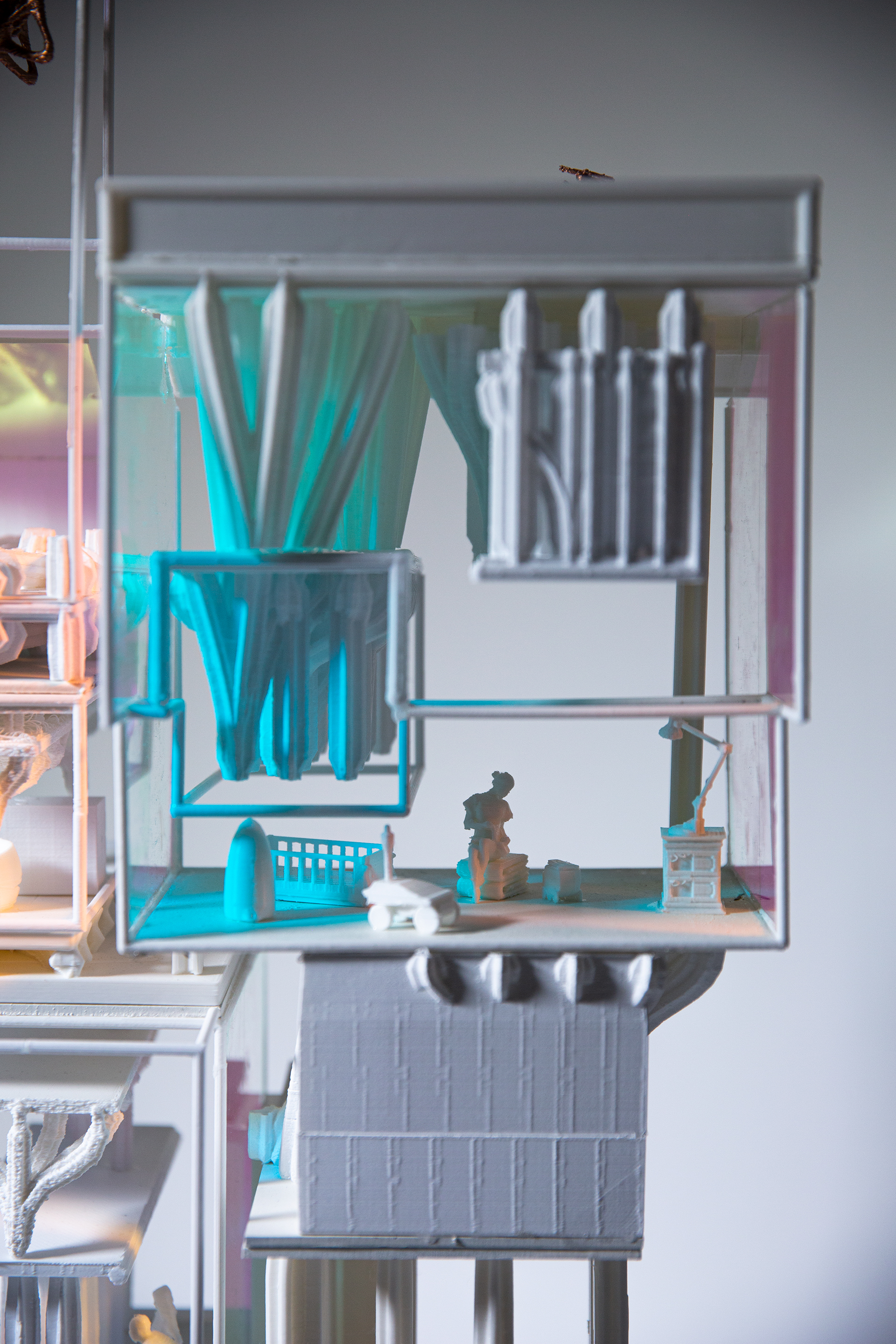

Two students walking through the Daniels Corp amphitheatre where project models are displayed

23.05.26 - Explore our End of Year Exhibitions

All events are free and open to the public. No registration required.


End of Year Show 2025/26

A Daniels tradition encompassing a wide range of projects, this exhibition showcases student work from across our degree programs in architecture, forestry, landscape architecture, urban design, and visual studies. The models, drawings, graphics and videos displayed in the third floor studio at 1 Spadina Crescent, demonstrate our students' approaches to the objects and environments they imagine, create and nurture.

Opens May 23 (Doors Open Toronto) and closes June 3, 2026


Existing Futures: Teaching Experiments in Maintenance, Media and Urban Occupation

Exhibition talk: Sunday, May 24, 5:00 p.m.  in the Daniels Building Main Hall  |  Larry Wayne Richards Gallery hours extended Sunday, May 24 until 6:00 p.m.

Curated by
University of Tokyo Associate Professor of Architecture Yusuke Obuchi
Daniels 2025/26 Frank Gehry International Visiting Chair in Architectural Design

The future does not emerge from the constant pursuit of the new, but from reimagining what already exists.

This exhibition in the Larry Wayne Richards Gallery brings together teaching experiments and student work from three courses Obuchi taught at Daniels: “Radical Maintenance,” “Analog Machine: I Am Here” and “Urban Nomad.” Through acts of observation, repair, reconstruction, and fabrication, these projects explore how architecture can emerge from unrealized potentials already present in our environments, materials, and social conditions.

This exhibition is generously supported by the Frank Gehry International Visiting Chair in Architectural Design endowment.


MVS in Studio Art Graduating Student Exhibitions

Architecture + Design Gallery
Daniels Building, 1 Spadina Crescent (Map)

Opening reception: Thursday, April 30, 6:00—8:00 p.m.

The Art Museum at the University of Toronto, in partnership with the Daniels Faculty, is pleased to present the graduating projects of the 2026 Master of Visual Studies (MVS) in Studio Art graduate students: Helio Eudoro, Rita Ferrando, Pamila Matharu, and Cullen Ritchie. The exhibitions mark the culmination of years of rigorous research and studio practice, offering a first public look at new bodies of work by each graduating student artist.

Closes July 15, 2026

Helio Eudoro, Shrine, 2026. Assemblage (detail), 30″ x 28″ x 24″. Image courtesy of the artist; Rita Ferrando, Modern Nature, 2026. Film still, 1.33:1, colour. Image courtesy of the artist; Pamila Matharu, Untitled 2, 2025. Colour photograph, variable dimensions. Image courtesy of the artist; Cullen Ritchie, Half Mile, 2026. Video still, 16mm film print, digitized, 02:30 mins, looping. Image courtesy of the artist.


MVS in Curatorial Studies Graduating Student Exhibitions

Opening reception: Wednesday, May 6, 6:00–8:00 p.m.

Little and Often traces how our relationships to land, material, and community are sustained within disturbed landscapes and conditions of precarity. Working with seeds, soils, mushrooms, and plants, the artists in this exhibition foreground resilience as a collective, relational practice, continually shifting under constraint. Little and Often is curated by Chloe Gordon-Chow and features works by Maureen Gruben, Rachel Crummey, Miguel Caba, Rana Nazzal Hamadeh, and Meech Boakye and Bhavika Sharma.

Curated by Gia Liapi, Blind Spot explores the potentials of finding new uses for the tools already in our hands. Through video, installation, performance, and software, artists Shadi Habib Allah, Shu Lea Cheang, Jeremy Laing, Lou Sheppard, and Iris Touliatou examine how legibility and classification produce value to open conversations about alternative architectures to learn from and with.

The exhibitions are produced as part of the requirements for the Master of Visual Studies (MVS) in Curatorial Studies at the Daniel Faculty. 

All images courtesy of the artists (Little and Often): Rana Nazzal Hamadeh, Something from there, 2020. Still from video, 07:00 mins, Arabic, English (with subtitles in English); Maureen Gruben, Nuna Aliannaittuq, 2025. Process photo; 4,800 clay beads, cotton thread (size varies). Photo by Kyra Kordoski; All images courtesy of the artists (Blind Spot): Shadi Habib Allah, Did You See Me This Time With Your Own Eyes?, 2018. Single-channel HD, 07:00 mins. Image courtesy of the artist and Sylvia Kouvali, London / Piraeus; Shu Leah Cheang, UTTER, 2023. 36-minute video loop. Image courtesy of the artist.

Photo of the graduate design studio at top of page by Alice Xue Photography

Mason White

23.04.26 - Mason White appointed dean of U of T’s John H. Daniels Faculty of Architecture, Landscape, and Design

Mason White, an award-winning scholar and designer, has been appointed dean of the University of Toronto’s John H. Daniels Faculty of Architecture, Landscape, and Design.

A faculty member at Daniels since 2005, White is an expert in architecture, urban design and the relationship between architecture, environment and society – with a focus on cold climates.

He will assume his new role on July 1, 2026 for a five-year term. His appointment was approved Wednesday following an extensive international search. 

“Having taught here for 20 years already, it is an incredible honour to have the opportunity to support our students, faculty and staff as they pursue even greater heights,” said White. “I’m really excited for the challenge ahead and for the future of this faculty, which brings together a remarkable diversity of perspectives across disciplines and practices.”

White is renowned for his research, architecture and design work in cold environments and across scales – from individual buildings to entire cities and regions. A founding partner of Lateral Office, an interdisciplinary design practice, White often collaborates with Indigenous partners on community‑empowering research and design projects.

He has held several leadership roles at Daniels, including director of the master of architecture and master of urban design programs, as well as the post-professional master of architecture and master of landscape architecture programs.

Trevor Young, U of T’s vice‑president and provost, congratulated White on his appointment.

“Professor White’s commitment to research and practice excellence will be key to the continued success of the John H. Daniels Faculty of Architecture, Landscape, and Design in the years ahead,” said Young. 

“His scholarly vision and collaborative focus will guide Daniels students and faculty in exploring innovative ways to shape the spaces and experiences that enrich our lives, and in responding thoughtfully to social and environmental challenges.”

Young also thanked Professor Robert Levit for his exceptional service as acting dean since August 2023.

A Fellow of the Royal Architectural Institute of Canada, White has served as a primary investigator and collaborator on several major arts and tri‑council grants – with more than $2.4 million in funded research – and has lectured and exhibited extensively across the United States, Canada, South America, Europe and Asia. 

He is the founding editor of the journal Bracket, co-author of Many Norths: Spatial Practice in a Polar Territory, co-editor of Third Coast Atlas: Prelude to a Plan and has had his work and writing featured in major newspapers, magazines and journals.

With bachelor’s and master’s degrees in architecture from Virginia Tech and Harvard University, respectively, White said Daniels’ evolution – from a school of architecture, landscape architecture and urban design to a faculty that also includes forestry and visual studies – puts it in a unique position to perform high-impact interdisciplinary work.

“There are powerful overlaps between disciplines that are all hosted under one roof here – literally,” said White, who has received multiple awards for his work – both personally and via Lateral Office.

“From realms like forestry and landscape architecture, whose connections are obvious, to less apparent – yet promising – links between urban design and visual studies, we can combine how these disciplines have traditionally worked while examining their shared interests.”

As dean, White said he is eager to strengthen relationships with Daniels alumni and foster new research partnerships at U of T and beyond – all while emphasizing collaboration, creativity and community engagement.

“We want to support and train design leaders who are collaborative and creative,” he said. “That means finding a balance between the technical skills that students need and the human, community‑facing leadership the world requires.”

Story by Rahul Kalvapalle republished from U of T News

Photo by Polina Teif

Daniels Design Discovery Gif with images of the program

01.04.26 - Registration now open for Daniels’ summer program for high school students

Designed for high school students, our summer program provides a comprehensive introduction to architecture and explores different ways of seeing, thinking and making.

We offer two 2-week courses in both July and August 2026 for ages 14 to 18.

New this year is a a 2-week portfolio design course for ages 16-18 (graduating high school in 2026 or 2027), ideal for students interested in applying to university programs in architecture and visual studies.

Existing Futures - Denise Akman

Existing Futures: Teaching Experiments in Maintenance, Media, and Urban Occupation

-


Larry Wayne Richards Gallery
Daniels Building, 1 Spadina Crescent

Special exhibtion talk: Sunday, May 24 at 5:00 p.m. in Daniels Main Hall

Wrapping up his year as the 2025/26 Gehry International Visiting Chair in Architectural Design, Yusuke Obuchi will deliver a talk for Existing Futures, a new collaborative exhibition of student work opening at the Larry Wayne Richards Gallery at 5:00 p.m. on Sunday, May 24. This talk, happening during Doors Open TO, is free to the public. Join us! 

Yusuke Obuchi is an Associate Professor of Architecture at the University of Tokyo, where he has directed the Obuchi Laboratory since 2010 and co-founded the Advanced Design Studies Program. Previously, he co-directed the Design Research Laboratory at the Architectural Association in London (2005–2010). He studied architecture at Princeton, SCI-Arc, and the University of Toronto, and has taught at Princeton, Harvard GSD, Hong Kong University, the University of Kentucky, and NJIT.

Existing Futures

Teaching Experiments in Maintenance, Media, and Urban Occupation.

The future does not emerge from the constant pursuit of the new, but from reimagining what already exists.

This exhibition brings together work across three courses: Radical Maintenance, Analog Machines – I Am Here, and Urban Nomad. Through acts of observation, repair, reconstruction, and fabrication, these projects explore how architecture can emerge from unrealized potentials already present in our environments, materials, and social conditions.

Taught and curated by Yusuke Obuchi, 2025 – 2026 Frank Gehry International Visiting Chair in Architectural Design at the Daniels Faculty of Architecture, Landscape and Design, University of Toronto. 

This exhibition is generously supported by the Frank Gehry International Visiting Chair in Architectural Design Endowment.

05.05.26 - Delia Pan and Devika Singh awarded Wilson Undergraduate Research Prize

Delia Pan (photo 1) and Devika Singh (photo 2) pictured with Timothy Chan, Associate Vice-President and Vice-Provost, Strategic Initiatives, their thesis supervisor Assistant Professor, Teaching Stream, Simon Rabyniuk, donor Peter Shannon Wilson, University Chief Librarian Larry P. Alford. Photo 3: The winners of the 2026 Patricia and Peter Shannon Wilson Undergraduate Research Prize: Devika Singh, Delia Pan, Parmin Sedigh Tonekaboni, Alex Drotenko, Sabrina Isabelle McLennon and Lorraine Pan (all photos by Paul Terefenko). 

In today’s era of rapid technological advancement, with more information at our fingertips than ever before, it can be easy – and tempting – to fast-track the research process. For students who choose to dig deeper, the results can be surprising, enlightening and even groundbreaking. The Peter and Patricia Shannon Wilson Undergraduate Research Prize celebrates these exceptional students who use U of T’s libraries to unlock exciting new pathways of scholarship. 

Now in its 10th year, the Wilson Prize was established through the generosity of Peter and Patricia Shannon Wilson, whose endowment honours their family’s deep belief in education and a lifelong connection to U of T, its staff, and its libraries.

“Here at U of T, we pride ourselves on being at the forefront of research excellence and academic achievement, not only in Canada, but globally,” said University Chief Librarian Larry P. Alford in his remarks at the event. “The Patricia and Peter Shannon Wilson Undergraduate Research Prize is a testament to this commitment, and it’s clear that this recognition leaves a lasting impact.” 

At this year’s awards ceremony on April 17th at the Thomas Fisher Rare Book Library, six winners and their supporting instructors spoke about their winning projects, connected by one common thread: a shared commitment to critical and innovative thinking, supported by library research. 

This year, two fourth-year architectural studies students from Daniels received a Wilson Prize: Delia Pan and Devika Singh were both supported by Assistant Professor Simon Rabyniuk

Pan’s thesis project “Between Renewal and Memory: A Resident-Centered Framework for Taiwan’s Aging Housing” explored urban renewal, gentrification, and housing accessibility in Taipei. Pan started with broader search terms and targeted filters, which led her to a key article via ScienceDirect. She also explored U of T’s Chinese and Japanese-language holdings to deepen her area of scholarship: “I’m grateful that U of T’s collections include texts from diverse cultures and languages,” she says. “This multilingual approach allowed me to engage with Taiwanese and Japanese scholars’ perspectives directly, rather than through translated intermediaries." 

Pan will begin her master of architecture at Cornell University this September.

Singh’s winning project “A Choreography of Things: The Making of Indo-Caribbean Identity” is a micro-history of the Guianese bottom house - a covered ground-level area common to Guiana’s Indo-Caribbean and Afro-Caribbean communities.

Singh met with librarians, including Eberhard Zeidler Library’s head librarian Cathryn Copper, to explore subject-specific databases and tools for interdisciplinary research. “These one-on-one consultations reframed the library as a collaborative research community rather than a passive resource,” Singh says. She also conducted interviews with her Guyanese father as part of her research and used library resources like architecture drawings and colonial records to supplement his memories.

Singh will pursue further graduate study in architectural history at the Architectural Association (AA) School in London, U.K. 

Simon Rabyniuk, Assistant Professor, Teaching Stream, at the Wilson Undergraduate Research Prize ceremony hosted by U of T Libraries at the Thomas Fisher Rare Book Library (all photos by Paul Terefenko).

“The Wilson Prizes not only recognize extraordinary student work — they also highlight the guidance of faculty, librarians, and mentors who support students through every stage of the research process,” said Timothy Chan, Associate Vice-President and Vice-Provost, Strategic Initiatives in his remarks at the ceremony. “The generosity and vision of Peter and Patricia Shannon Wilson have opened doors for students to make meaningful contributions to academic life at U of T.”

Thanks to the support of the Wilsons, the mentorship of UTL librarians and the library’s vast repository of archival resources, collections and materials, this year’s Wilson Prize winners have developed the confidence, skills, and intellectual curiosity that will guide them through lifelong learning. After all, every great research journey begins with a question – and the library can be the key that unlocks the answer.

Read the full story by Alison Lang: A decade of discovery with the Wilson Research Prize

Photos by Paul Terefenko courtesy of U of T Libraries

Introduction to Bookbinding

-

Eberhard Zeidler Library, In-person
Daniels Building, 1 Spadina Crescent

Registration is required. If no seats are available, sign-up for the waiting list. Open to U of T undergraduate and graudate students. 

In this beginner-friendly workshop, participants will learn the essentials of bookbinding by exploring two to three foundational binding structures, such as the pamphlet stitch, stab binding, and other simple sewn formats. Guided step-by-step through each technique, attendees will fold, sew, and assemble their own handmade books using a range of papers, threads, and bookbinding tools.

Whether you are a student of design disciplines or visual studies, or simply curious about the craft of the book, this session offers an accessible introduction to the tactile and creative possibilities of bookmaking. Participants will leave with a small collection of handbound books and the skills to continue experimenting with binding techniques independently.

No prior experience is required. Attendees are encouraged to bring any materials that inspire their own creativity (photos, clippings, stickers, paper, etc.), which they can use to decorate their book objects, but all necessary materials will be provided.

University of Toronto Student Leadership Awardees

15.04.26 - Five Daniels undergraduates receive the University of Toronto Student Leadership Award

The University of Toronto Student Leadership Awards recognize graduating students whose exemplary leadership contributions have significantly impacted the university and the U of T experience of their peers.

"Recipients exemplify service, integrity and a commitment to enhancing the student experience here at Daniels and across the campus," says Robert Levit, acting dean of the Daniels Faculty. "Their efforts help build a stronger and more connected community. I congratulate the recipients and thank all student leaders for their invaluable contributions to student life."

Congratulations to the 2026 awardees:

Ambareen Fatima
Hon. BAAS with a minor in Urban Studies and a Certificate in Sustainability of the Built Environment

As co-president of the Future Living Lab (FLL) and in her roles as VP External and VP Equity with the Architecture and Visual Studies Students Union (AVSSU), Ambareen founded the Undergraduate Firm Fair, one of the faculty’s largest student-led professional initiatives. Along with the FLL Podcast, Ambareen led tri-campus initiatives to bridge gaps between Daniels and other faculties. She also led research labs, architecture competitions, panels and large-scale events to connect students with industry, research and community. Her work centres on advocacy, equity and building inclusive spaces that empower students to grow and thrive.

Mahroo Mansouri
Hon. BAAS (Design Specialist stream)

Mahroo served as Vice President of Communications for AVSSU, where she managed communications with students and external partners and led initiatives including the Women in Art and Design panel and the Humans of Daniels campaign to foster community and representation. She is also the co-president of the Women’s Student Association at U of T and has been actively involved in multiple Daniels clubs and mentorship programs.

Jacob Muller
Hon. BAAS (Design Specialist stream) with a minor in Jewish Studies and a Certificate in Sustainability of the Built Environment

AVSSU is the elected student government representing and advocating for the Daniels undergraduate student body. Jacob is recognized for his leadership within AVSSU over four years, culminating in his role as president in 2025/26. Jacob is further recognized for his leading contributions as a founding member of Scaffold* Journal, an annual, peer-reviewed design journal, and serving as its managing director in 2025/26.

Emily Sun
Hon. BAAS (Technology Specialist stream)

Emily is an active U of T leader and volunteer, leading initiatives with Applied Architecture Landscape and Design (AALD), a student group promoting a distinctly hands‐on approach to architecture, landscape, and design for both undergraduate and graduate students through tutorials and workshops. The collective supports Daniels students by building practical skills and fostering mentorship and connections with Toronto’s broader design community. Emily served as AALD vice president and most recently as president.

Julien Todd 
Hon. BAAS (Technology Specialist stream)

Julien is a co-founder of the Indigenous Student Coalition at Daniels, Black Architects and Interior Designers Association (BAIDA) student chapter and a mentor with Building Black Success through Design (BBSD), a Daniels outreach program for Black youth. A member of the from the Métis Nation of Alberta, Julien is a Bear Clan Leader for the Indigenous Students Association at U of T, committed to the spiritual, physical, emotional and mental well-being of the Indigenous student body and community members.

MVS Studio Art Graduating Student Exhibitions

Master of Visual Studies (MVS) in Studio Art Graduating Student Exhibitions

-

Architecture + Design Gallery
Daniels Building, 1 Spadina Crescent (Map
Hours: 12:00 p.m. to 5:00 p.m., M-F

Opening reception: Thursday, April 30, 6:00—8:00 p.m.

The Art Museum at the University of Toronto, in partnership with the Daniels Faculty, is pleased to present the graduating projects of the 2026 MVS in Studio Art graduate students: Helio Eudoro, Rita Ferrando, Pamila Matharu, and Cullen Ritchie. The exhibitions mark the culmination of years of rigorous research and studio practice, offering a first public look at new bodies of work by each graduating student artist.

This event is free and open to the public. No registration required.

Students in the design studio

Tours of the Daniels Building for prospective & newly admitted students

Join a campus tour

Discover the Daniels Building at 1 Spadina Crescent

Step inside one of Toronto’s most iconic architectural spaces—the home of the John H. Daniels Faculty of Architecture, Landscape, and Design at the University of Toronto. Our building features:

  • 30,000 sq. ft. of studio space designed for creativity and collaboration;
  • A grand main hall for lectures, talks, and public events;
  • 8,000 sq. ft. public design gallery showcasing innovative work;
  • An on-site library and a state-of-the-art digital fabrication lab equipped with the latest design technology.

Join a campus tour

Explore our spaces, meet our community and experience what makes Daniels unique. Choose a date from the calendar and register for your tour today!

Completed in 2017, the Daniels Building was designed by Nader Tehrani and Katherine Faulkner of NADAAA, in collaboration with Adamson & Associates, Public Work, and ERA Architects.

Photo above by Alice Xue Photography

Drawing of a round table with people in blue winter coats

Sikumit Aisimajugut - At Home on Ice - ᓯᑯᒥᑦ ᐊᐃᓯᒪᔪᒍᑦ

-

Daniels Building, 1 Spadina Crescent 
Main Hall, DA170  

Organized around two panels, the “Sikumit Aisimajugut / At Home on Ice” roundtable will examine the idea of the home from the inside-out and outside-in in Arctic cultures. “Inside-out” will centre on the ideas shaping cultural understandings of housing, from the ways people live inside the home, to going out on the land as an extension of the home, as well as the importance of traditions such as country food. “Outside-in” will consider the larger, often exterior, forces shaping housing issues in the North—policy, logistics, and climate change—and challenges in delivering appropriate housing in the region. Speakers from government, industry, cultural advocates, planning, and architecture, all with lived or working experience in Inuit Nunangat, will share perspectives, and participate in a unique round-table discussion. In an era when housing in the Canadian south is understood as commodity and property, lessons from Inuit Nunangat question what constitutes a house, a home, and a community from the inside-out and the outside-in. 
 

Agenda

9:00 a.m. - Arrivals & Welcome
9:30 a.m. - Angela Aula - Nunangat Primer
10:00 a.m. - 1:00 p.m. - "Inside Out"
  — Nicole Luke
  — Jesse Ajayi - Northern Futures
  — Stephen Westlake - Nunavut Housing Corp.
  — Catherine Orzes - Blouin Orzes architectes
Roundtable 1 Discussion with James Bird, Lola Sheppard, Mason White

2:00-5:00 p.m. - "Outside-In"
  — Shyniaya Duffy
  — Guy Yango - Kativik Regional Government
  — Rachel Michael - Nunavut Tunngavik Inc.
  — Helena Lennert - TNT Architects, Nuuk
Roundtable 2 Discussion with Mark Bennett, Lola Sheppard, Mason White


“Sikumit Aisimajugut” roundtable is organized by Mason White (Daniels Faculty, University of Toronto) and Lola Sheppard (University of Waterloo). It is supported by The Irving Grossman Fund in Affordable Housing. 

Speakers

Jesse Ajayi (Ottawa) is a community planner and partner at Northern Futures Planning with 14 years of experience in northern and Indigenous communities, including four years living and working in Nunavut. His work spans land use policy, housing, and urban design in Arctic and remote contexts, as well as teaching and professional training for municipal planners grounded in community-led development review and land administration.

Mark Bennett (Toronto) is an Inuk designer based in Tkaronto, Canada, originally from western Ktaqmkuk (Newfoundland). His practice in graphic and publication design centers on collaboration with artists, galleries, architects, and cultural institutions, including the Inuit Art Foundation, Fogo Island Arts, Joar Nango, and the National Gallery of Canada. His studio design practice and research engage Indigenous design methodologies through an exploration of the Japanese Metabolist movement, with a focus on circumpolar northern architectural traditions.

James Bird (Toronto) is a proud member of the Dënesųłı̨né and Nêhiyawak nations from Tthebati, N.W.T. He is also affiliated with the Northwest Territories Métis Nation. He is currently a PhD candidate in architecture. His doctoral work, titled "Dënesųłı̨né Building Code: Integrating Tradition and Innovation into Policy," presents an inclusive framework for a Northern Building Code tailored to the extreme climate conditions of the Northwest Territorie
     
Shyniaya Duffy (Calgary) is an Inuk from Coral Harbour, Nunavut, raised on Treaty 7 Territory in Alberta whose work explores identity, cultural reconnection, and the intersection of Indigenous and Western worldviews in architecture. As an intern architect (Two Row Architect), sessional instructor and Indigenous Student Mentor (SAPL, University of Calgary), she integrates Indigenous perspectives into architectural education and challenges euro-centric views and design within the built environment.
   
Helena Lennert (Nuuk) is a partner at TNT Nuuk in Greenland. She works with architecture rooted in people and the specific identity of place, with a strong focus on functionality and usability. Her practice spans from early-stage programming and strategic definition to detailed design and project development, always informed by cultural context and the particular conditions of building in Greenland.
     
Nicole Luke (Winnipeg) is an emerging Inuk Architectural Intern whose practice bridges architecture and cultural narrative. With family ties to the Kivalliq region of Nunavut and experience navigating both northern and urban environments, she brings a unique understanding of the design and construction challenges faced by Inuit/Arctic communities. Her work is grounded in Indigenous values, emphasizing responsiveness, inclusivity, and sustainability, while exploring how the built environment can foster cultural expression, social resilience, and economic empowerment.

Rachel Seepola Michael (Iqaluit) is a fierce Inuk woman who was raised by her Grandparents Simonie and Martha Michael in Apex (Niaqunnguuq), Iqaluit, Nunavut. Rachel Michael graduated at Inukshuk High School in 2014 in Iqaluit, and is now the Policy Analyst on Homelessness for the Department of Economic Advancement for Nunavut Tunngavik Inc. Rachel, currently working and living in her hometown. She is using her lived and work experience to advocate for Housing as a Human Right for Inuit, as well as equitable and accessible Mental Health Supports and Housing.
     
Catherine Orzes (Montreal) is co-founder of Blouin Orzes architectes, a Montreal-based firm dedicated to northern projects. The work of Blouin Orzes can be understood as an exploration of the Canadian Arctic through architecture. Their approach is based on careful listening, sustained community engagement, and a mastery of the technical aspects of building in a northern environment in a time of climatic changes.

Stephen Westlake (Arviat) has worked at Nunavut Housing Corporation as Programs Manager for Nunavut’s Igluliuqatigiingniq 3000 Homes Strategy, leading collaborative community housing initiatives and managing programs such as the Nunalingni Piruqpaalirut Growth Fund and the Supported Housing Capital Program. His 15+ year experience in Canada spans supported housing, homelessness prevention, and supported employment.

Guy Yango (Kuujjuaq) is the current Executive and Political Advisor for the Kativik Regional Government (KRG), the administrative body governing the territory north of the 55th parallel in the province of Quebec). He oversees the strategic direction of the organization on behalf of the Chairperson of the KRG, and has been in the role since 2022.


An exhibition of the same title runs in the Larry Wayne Richards Gallery at the Daniels Faculty until February 16, 2026.